
Let's be honest, a sloped backyard or a compact plot can feel like a challenge when you're trying to grow things. Luckily, terraced gardens are excellent for transforming these less-than-ideal spots into more functional and interesting areas.
These 30 practical ideas will help you make the most of your unique space.
Integrate Low-Level Lighting Into Concrete Steps

Small, circular fixtures are embedded directly into concrete risers, casting a warm, subtle light on garden steps. This provides clear visibility for evening passage and gives the outdoor space a modern glow.
Stack Wooden Planters for Tiered Garden Levels

Substantial wooden planters are stacked to establish distinct garden levels. Their warm wood tones soften the landscape, offering ample space for diverse plantings of vegetables or flowers to thrive at varying heights.
Cream Stone Planters Create Modern, Multi-Level Garden Beds

Broad, low planters of smooth, cream-colored stone form multi-level planting beds. They provide a clean base for greenery and trees, with integrated steps allowing natural movement through the garden levels and softening modern lines.
Natural Stone Walls Create Textured Garden Levels

Rough-hewn, stacked stone blocks form garden retaining walls, establishing distinct planting tiers. Their varied shapes and colors allow for layering different plant types and textures, contributing a rustic, organic feel that softens modern garden designs.
Integrate a Wooden Bench Into a Stone Retaining Wall

A wooden seating area extends directly from a stone retaining wall, creating a built-in bench. Its light-colored surface features dark stripes, offering a place to rest in the terraced garden.
Tiered Wooden Planters Define an Outdoor Room

A series of raised wooden planters delineates zones on a sloped yard. They surround a central deck area with a table and chairs.
Wooden Beam Retaining Walls Define Terraced Garden Beds

Weathered wooden beams construct tiered garden beds, defining distinct levels for planting. Stacking them creates a sturdy structure that also offers a natural way to manage slopes.
Stack Cream Stone Blocks for Layered Garden Beds

Stack light-colored stone blocks to create distinct planting levels. Their smooth, creamy finish allows flowers and greenery to show clearly, making the most of planting space on a slope.
Curved Stone Walls Create Multi-Level Garden Beds

Rough-hewn stone walls are stacked to form distinct planting levels. This construction softens the landscape, providing a tiered setting for colorful tulips and other spring blooms.
Soften Stone Walls with Tiered Ornamental Grasses

Layered ornamental grasses soften hardscaping. Clumps of blue fescue and other fine-textured grasses spill over stone walls and wooden steps, bringing a naturalistic flow to the multi-level garden design.
Rusted Metal Edging Creates Zigzag Garden Beds

Rusted metal edging shapes planting areas that zigzag up a slope. It separates gravel paths from garden beds.
Sculpt Greenery to Soften Stone Garden Levels

Rough-hewn stone walls delineate garden levels. Neatly sculpted, rounded bushes and low-lying greenery soften these walls, presenting varied heights and forms within the space.
Integrate Rock Gardens Into Concrete Retaining Walls

Small rock gardens are set into tiered concrete retaining walls. Pockets of small stones and low-growing greenery soften the layered walls, delineating planting areas and bringing a naturalistic detail to the modern hardscaping.
Concrete Steps With Integrated Planter Beds

Dark grey concrete forms steps and surrounding retaining walls for a multi-level garden. Built-in planter beds integrate directly into this clean, geometric structure, allowing for smooth planting alongside the pathway, where greenery softens the concrete lines.
Stack Wooden Beams for Modern, Layered Garden Beds

Wide, horizontal wooden beams stack to arrange plants at varying heights. The wood's warm, natural tones soften the raised beds' edges, marking separate zones in your outdoor space.
Wooden Planter Boxes Create Tiered Garden Steps

Wooden boxes form garden steps, creating distinct planting levels in a terraced garden. These stacked planters also serve as a functional pathway up a slope.
Gabion Walls Create Multi-Level Garden Beds

Gabion walls filled with stones build tiered garden beds. This method effectively contains soil on a slope, allowing for diverse plantings across multiple levels, while the textured stone provides a natural backdrop.
Concrete Terraces With Integrated Staircase for Garden Access

Concrete terraces form a multi-level garden, incorporating a staircase. Continuous concrete walls provide access to different planting levels for flowers and greenery, maintaining a clean, modern appearance.
Weathered Timber Posts Border Stone Steps for Garden Levels

Chunky, weathered timber posts delineate levels in a terraced garden, bordering stone steps. This rustic approach adds texture while separating pathways from planting areas.
Low Cream Planters Soften Stone Stairways

Wide, low-profile, cream-colored planters integrate into terraced garden designs, softening the hard lines of stone staircases. Their material offers a subtle counterpoint to the surrounding stone, while layered planting within brings greenery closer to the built structure.
White Rendered Walls With Brick Accents Create Sculpted Garden Levels

White rendered walls, edged with contrasting brick, delineate multiple garden levels. These walls establish distinct planting areas, and integrated lighting extends the garden's use into the evening.
Stone Walls and Corten Steps for Multi-Level Garden Access

Weathered stone walls define garden levels, with steps built from corten steel. This combination provides a practical way to navigate sloped terrain, using natural materials to soften the yard.
Curved Corten Steel Edging Creates Flowing Garden Steps

Curved corten steel edging defines garden steps with a natural, organic feel. The rusted metal creates a warm contrast with the nearby plants and gravel paths, adding movement to a sloped yard.
Rusted Metal Steps With Integrated Wooden Seating Areas
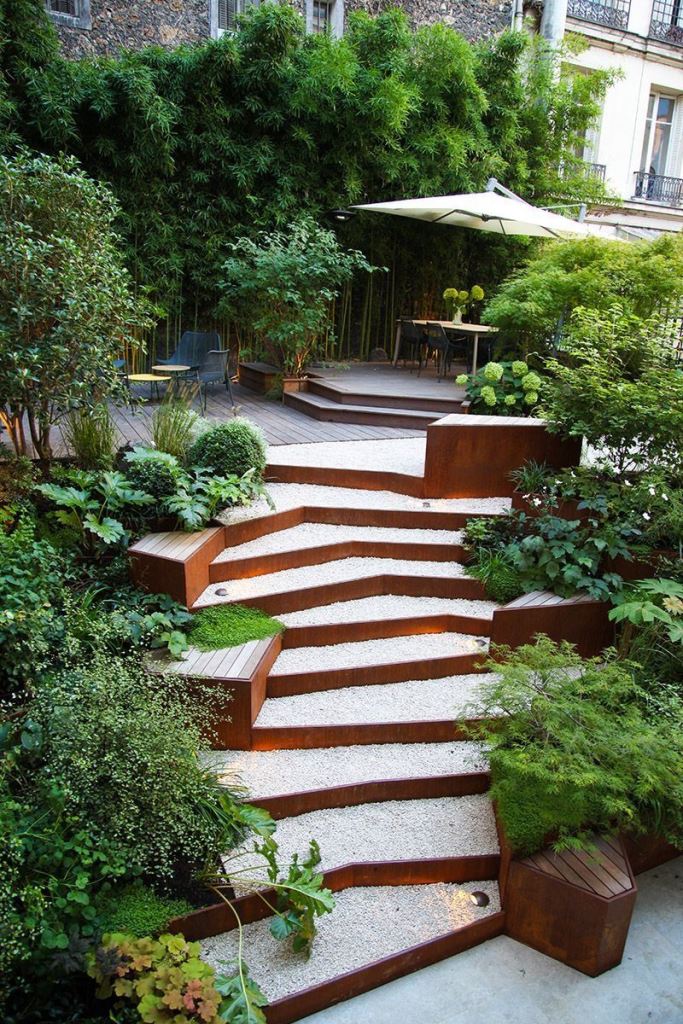
Rusted metal edging defines terraced garden steps, which feature integrated wooden seating areas. This provides a place to pause and enjoy the outdoor space.
Dark Planters Create a Living Staircase Effect

Dark, rectangular planters integrate directly into garden steps. Stacked along one side of a stone staircase, they provide a visual counterpoint, softening the hard lines with a layered effect of greenery in the transition space.
Tall Ornamental Grasses Soften Stone Retaining Walls

Large plumes of ornamental grass, such as pampas grass, soften the hard lines of stacked stone retaining walls. Their feathery, light-colored fronds add an airy quality and movement, standing out against the neutral stone of the terraced garden levels.
Dark Stair Treads Create a Modern Path Through Terraced Beds

Dark stair treads, set against lighter stone or concrete, create a strong visual path through a terraced garden. These steps contrast with nearby plants and lighter planters, defining garden levels with a clear route through the space.
Blue Fescue Grass Creates a Soft Border Along Walls

Mounds of blue fescue grass, planted along concrete retaining walls, form a gentle transition to softer garden elements. This cool-toned ornamental grass has a wispy texture, softening the wall's expanse and appearing calm against surrounding greenery and darker foliage plants.
Concrete Retaining Walls Define Vegetable Beds on a Steep Slope

Concrete retaining walls build distinct, level planting areas on a steep hillside. Their sturdy, clean surfaces contrast with the natural slope and greenery.
Tiered Corten Planters Create Cascading Garden Steps

Rusted metal planters define garden levels in a tiered arrangement. These containers, filled with neatly trimmed boxwood spheres, soften the sharp lines of concrete steps.
